Saturday, January 10, 2015

OES Reads: Building Excitement for a Whole-School Reading Project

It's *almost* here.
And good thing, because it is becoming harder and harder not to talk about it.

We've been building excitement and anticipation for our whole-school family reading initiative since mid-December. And it's almost time to make the big announcement.

We call our initiative OES Reads. Three years ago, we were trying to find creative ways to connect school and family learning and to bridge the physical separation (upstairs/downstairs) between primary and intermediate classrooms in our building. The result was establishing and organizing the first OES Reads The premise of our program is similar to the well-known One School, One Book project, as we have selected one book that all students, families, and staff (including office personnel, lunchroom workers, custodial staff, and bus drivers) read during the same window of time.

Our first two years were successful, but as with any program, we are always seeking ways to keep involvement and participation high. Choosing a single book (already hard to do!) for the entire PreK through 6th grade population was a challenge. In our third year, we've adjusted course to try something different. We decided to make two book selections by grade-spans (to attend to interest level and hopefully engage more students) by one author!

This shifted our planning a bit. Adding a second book meant doubling the work in the preparation phase. But it also has rounded out the literacy immersion of our project, too. Since the common factor in this year's OES Reads selections is one author, we've found excellent opportunities to incorporate writing into our whole-school project.


Never doubt the value of caution tape to promote curiosity!
Before vacation, we made a bulletin board display. Lots of vague spots made for wonder: a large unknown image to represent the author, a set of "clues," and caution tape. (Aside: If you're looking for a fool-proof way to attract kids' attention, stretch caution tape over what they should notice. Works like a charm!) The visual worked wonderfully at reminding everyone that OES Reads was coming.

This week, everyone returned from vacation to find two new book covers arrived to stand beside the two book covers from the previous two years of OES Reads. Only, these two new covers were draped with black plastic and (again) caution tape. Their very obvious presence reminded students that the big reveal is getting closer. Daily, a new clue about the author was revealed on the bulletin board and shared as a morning announcement. Students started having conversations about authors they know and if any of those authors could fit the clues. Then, on Thursday, the unthinkable happened... The office interrupted our classrooms to announce that the book covers had gone missing! Suddenly, the students were in motion, abuzz with suspects and possible motives, trying to solve this evident problem. Our literacy coach shared the story of students she had seen working in the hall who had to be stopped from tearing off to the cafeteria to see. My students rallied, one girl going home to interrogate her mother, who spends a lot of time in our school as a PTA volunteer. As of Friday afternoon, the covers had not been returned, and sadly, in their place were only tape-outlines (think body-outlines) on the wall of the stage where they had been.

Though we've made changes to include two books by one author this year, one thing has not changed: curiosity. In fact, it may be in part because students and families have come to anticipate OES Reads each year. But the students' and families' curiosity and excitement continue to build and they are already invested in OES Reads, as evidenced this week. There were conversations about OES Reads, the mystery author, and the book covers happening all over the school. Second graders questioned me about the missing books on my lunch duty. Former students, fifth graders, checked in with me daily about the author clues and how they were whittling it down. "I'm determined to figure this out before Monday!" he resolved. (Actually, they had impressively figured it out on Wednesday's clue, but I didn't confirm or deny it!) Parents asked about how much longer they had to wait and verified the assembly time when picking up students from their after-school clubs. Kids and parents are talking. Everyone is awaiting the big reveal. 


But that doesn't happen until Monday.

On Monday, the whole-school and friends and family will get together for the OES Reads Kick-off Assembly. The teachers will act a little silly, the kids will get a little loud, and the author and book covers will be revealed. A new book will be presented to EVERY student. And then--together--we'll read.


And then I'll (finally!) be able to say more.

Use this link to read the next post in this blog series: The Big Reveal.

Friday, January 9, 2015

How to Outswim a Shark Without a Snorkel by Jess Keating


Last summer, I was one of the many readers who discovered Ana in Jess Keating's first novel, How to Outrun a Crocodile with Your Shoes Untied. I appreciated Ana's character right away. She's a nerdy (read: informed) introvert, an awkward and self-conscious middle school girl in all the ways in which you can relate. In Croc, Ana undergoes an evolution by summoning up her inner courage to share who she really is more confidently with the world...but most notably her intimidating classmates.

After closing the cover of Croc, I was glad to know I could look forward to Ana's return in a sequel adventure.

I wasn't disappointed.

When Ana's Sneer-enemy Ashley turns up as a student volunteer at the zoo for the summer, Ana's instincts kick into high gear. Convinced this is an elaborate plan to get revenge for an embarrassing incident at Ana's Croc presentation, Ana's defenses are heightened. Yet somehow, as Ashley spends more time at the zoo, and the girls work together in the shark exhibit, Ashley manages to coax Ana's mind into second guessing.

Can sharks be more friendly than they seem?

Ana, afraid to trust there may be more to someone than meets the eye, waivers in her position on Ashley, creating conditions in her head that steer her. But when a combination of dangerous mistakes cause Ana grief at the zoo, she must decide where her relationship with Ashley stands.


Reasons I Loved How to Outswim a Shark without a Snorkel
  • Ana lives in a zoo. No, really. How can that not perk your interest? Ana's family moved into the zoo in Croc, and the wild adventures continue in How to Outswim a Shark without a Snorkel. In this installment, Ana's grandfather has added a shark exhibit complete with a shark tank and touch tank. Though she prefers to work with reptiles, the marine exhibit will be her new assignment for the summer.
  • Drama. Ana has just recently (end of Croc) embraced her talent for talking to audiences at the zoo about the animals and creatures that inhabit the zoo displays. Ashley's presence as a zoo volunteer challenges Ana's still-developing confidence. Additionally, Ana is trying to remain close to her first best friend, Liv, who moved to New Zealand and is on an accelerated track to high school. And of course, there is that boy, Kevin, who Ana is trying to figure out-impossible as that is. Keating's cast provides the reader curiosity, suspicion, and the kind of drama you can't put down.
  • Character building. Keating steers Ana through questions without being heavy-handed. Ana's resulting inner conflicts are accurate portrayals of how middle school girls think about themselves and others. Ana's internal dialogue about decisions and what is right or wrong helps readers to think about their own position on friendships. Middle school students test their identities, trying to wrangle who they are and will be. Ana isn't exempt from this as she navigates a big important question: Who does she want to be?
  • The shark business (part one). Ana's learning about sharks and other marine life is embedded throughout the novel. From the marine life facts that begin each chapter to the true information that is woven into Ana and Ashley's time at the shark exhibit, readers of this fiction work will take away more information about marine animals than they may think at first glance.
  • The shark business (part two). Keating's use of the shark as a metaphor for the bigger message in Ana's story is artful. And that's all I'll say about that.
  • Who doesn't like to laugh? There is humor everywhere in this book. Whether your laughter is the result of Ana's incessant self-doubt or her description of her brother's thoughts and actions, something will make you chuckle. Maybe you'll be laughing because you, too, will find Ana reminds you of yourself a little.
  • Ana is special. Ana makes readers feel normal. Ana doesn't think her life resembles "normal" in any way, but her worries and fears, her fluctuating feelings about everything (friends, Ashley, boys!), her need for reassurance that she is ok...are oh-so-middle-school normal. I can't help but wonder what it would have been like to make a friend in Ana when I was a middle school reader.
  • It's as good as the first. Sometimes when you love a character in the author's first book, the second book can be a let down. Not so with Ana. Keating successfully takes Ana and who she has become with her new-found self-confidence and adds layers to her story with pressures from her cast of characters that challenge Ana to continue to grow into her own skin. Croc left me applauding Ana in her self-discovery, and so did How to Outswim a Shark without a Snorkel, for a different reason.


How to Outswim a Shark without a Snorkel, the second book in Jess Keating's My Life as a Zoo series, published on January 6 (Sourcebooks Jabberwocky). If you want a pair of books for that middle school girl who is still looking for her amazing inner self (ok, or even if she doesn't know she's looking), you'll want to know about Jess Keating's titles.

Learn more about author Jess Keating at her website and find her on Twitter at @Jess_Keating.

Monday, January 5, 2015

It's Monday, What Are You Reading? (1.5.15)

Every Monday bloggers all over the web participate in an effort to share books we have read and what we are excited about digging into. Thanks to Jen at Teach Mentor Texts and Kellee & Ricki at Unleashing Readers for hosting us all!

What I Read this Week:

The Exact Location of Home, by Kate Messner
(Bloomsbury USA Childrens, December 23, 2014)
     Kirby "Zig" Zigonski is back in this e-book companion to The Brilliant Fall of Gianna Z. While Gianna returns, too, the story is Zig's. Zig is grappling with feelings of loss and confusion when he is again disappointed by his father cancelling plans. Zig's feelings are quickly compounded when he and his mother face eviction from their apartment. Zig is certain that he can get his father to make things right again, especially when he picks up the lead on another geocaching fan who just might be his dad. 
     Zig's complex feelings are one reason to love him. Readers will be hard pressed not to have their empathetic hearts expand when let into his story and the challenges that every day presents, from added responsibility, to secrets, to just wanting things to be ok. 
Gone Fishing, by Tamera Will Wissinger, illustrated by Matthew Cordell
(HMH Books for Young Readers, 2013)
     Sam has long awaited the day he can go fishing with his father, just the two boys, so when his sister wakes early and his father invites her to come along, Sam's tune goes sour. His attitude doesn't improve when Lucy catches a few fish, and he does not. When alas he catches a fish that garners a lot of attention, Sam decides having Lucy along to share the trip wasn't so bad after all.
     A novel in verse, Sam's story will be easily accessible to striving readers, making this book a strong contender for passing off among students in my classroom. It is also a Maine Student Book Award nominee. The poems are labeled with type/style of poetry. This would be a comfortable way to ease students in to mentor texts for poetry as the writing is not intimidating.
Coaltown Jesus, by Ron Koertge
(Candlewick, 2013)
     Walker is dealing with the loss of his brother, Noah. The family is engulfed in typical grief and avoidance, and Walker knows things aren't right. He prays for help, and one day, Jesus appears in the flesh. A friendship, of sorts, develops between Walker and Jesus, and Walker shows evidence of healing.
     Something about this book was just right for me. Part of that was appreciating the unexpectedly witty and down-to-earth voice of Jesus in his interactions with Walker. The book is written in verse, making it a relatively quick read, but there is plenty to linger over, too.


Handle With Care, by Loree Griffin Burns, photographs by Ellen Harasimowicz
(Millbrook Pr Trade, 2014)
      Curious after learning that butterflies at the Boston Museum of Science were imported for the exhibit, Loree Griffin Burns asked questions about how and why butterflies are imported. This text documents the butterfly life cycle while also telling the story of butterfly harvesting in Costa Rica through their arrival in various locations.
     The text and photo pairings for this book are perfect. Students will flock to this book again and again for both it's stunning photography and for informative text in sizable bites. For readers who are overwhelmed with lots of print in most nonfiction books, this provides an equally informative text with excellent supports, respecting their thirst for knowledge and experiences.
Real Revision: Authors' Strategies to Share with Student Writers, by Kate Messner
(Stenhouse, 2011)
      Successful author Kate Messner invites teachers into her life as an author and into her classroom as a teacher with this collection of examples of activities and routines. To support teachers in making their classrooms "revision-friendly," Kate has drawn from the expertise of many other authors who share their approaches to revision.
     The ideas and suggestions in this professional text are incredibly practical. The style of writing and balance of information (teacher-to-teacher) is empowering to both writing teachers and student writers. The accounts included illustrate that the ways of revising text are as varied as writing itself. The back-stories of revision behind popular middle grade texts are enlightening, also.


What I am Currently Reading:
Inside Out and Back Again, by Thanhha Lai
(HarperCollins, 2013)


On Writing, by Stephen King
(Scribner, 2010)

What I am Reading Next:
Finding Serendipity, by Angelica Banks
Mark of the Thief, by Jennifer Nielsen
The Writing Thief, by Ruth Culham

Thursday, January 1, 2015

One Little Word, 2015

Sometime in the last week or so, it occurred to me that the new year was creeping nearer. As the talk of One Little Word simmered, I started a list of possible contenders in my writer's notebook and would daily add a word or two that would be deserving of my attention in 2015. Everything on that list appealed to me for it's own reason--from feelings they tapped to the challenge they issued. In the end, the word that I've picked is not a feel-good, glitsy word, but the very first word that came to mind when I started listing.


Last night, the last night of 2014, I made Tarte au Sucre. 

For those not on the up and up with French-Canadian cuisine, Tarte au Sucre is a one-crust sugar pie, made with brown sugar filling. Despite growing up in Madawaska, a small Maine mill town on the Canadian border, I had never attempted this sickly sweet Acadian treat. I hadn't even "helped" anyone to make it. But, my father was determined to see me use the new Acadian cookbook he gave me for Christmas, and he has a bit of a sweet tooth, too. When he asked for Tarte au Sucre for New Year's Eve, I headed to the kitchen.

Tarte au Sucre filling on the stove. On medium-low heat.
The recipe itself is pretty simple. In fact, I think I know it by heart already. All of the ingredients go into a pot at the same time, and the mixture is brought to a boil over medium-low heat. 

I imagine if there is a way to mess up this recipe, it's right there: medium-low heat.

Because, you see, the filling sat on the stove-top and and needed to be tended to. I had to continuously stir and stir and stir. If I didn't, the bottom would congeal, and once it did, the lumps wouldn't dissolve again into the desired smoothness. There was no stopping or looking away or multi-tasking. I had to keep the spatula moving, sometimes scraping, over that medium-low burner.

It took a long time.

Ok, it probably didn't, really. But it felt like it did. I was tempted to turn up the heat to expedite the cooking. I was teased by the conversations being had without me in the other room. I was happy to prepare this pie, but I wanted it to happen quickly, too.

There, in the kitchen stirring the brown sugar filling round and round and round over...yup, medium-low heat...my One Little Word choice was starkly clear.

Patience.

Because this scenario with the sugar pie is emblematic of so many less tangible things for me. Too often I am impatient. I'm not short-tempered (usually), and I'm typically patient with other people. But I am horribly impatient with myself.

I cause myself undue pressure by expecting things to happen quickly. I beat myself up when I don't seem to move fast enough or make enough progress on an unrealistic timeline. I have a half-million wonders, but I don't like to wait for answers. I don't want to wait to know or see or discover...I want to arrive quickly. I coax others--students, colleagues, friends--to be patient with themselves, to embrace their journeys, to allow themselves room to practice, grow, evolve...I teach, for goodness sake! But I apply a harder, less forgiving standard to myself.
My first-ever Tarte au Sucre

Being patient will mean accepting my abilities and my limitations, trusting time will help me "be." Patience will prompt me to slow down and curb the pressure. Giving less attention to the destination will heighten the path to "getting there."

In 2015, I want to be more comfortable with the need to stir the filling steadily, continuously. I want to embrace the time spent heating the filling as part of the process to the sweetness to come.

And the pie?
It got good reviews. 
I'll save you a piece.

Tuesday, December 30, 2014

Thirty Days of Writing: Looking Back

My December "Don't Break the Chain" Calendar
Today makes 30 days. December 1 to December 30.
I wrote for 30 minutes on every one of those 30 days.
My longest string yet.

So, on this last day of #writedaily30, I'm looking back.

Calling today "the last day" has me a little on edge. See, I can't really look at today as a "last" day. I've been successful with this challenge, but I can't afford to chance breaking the chain. I can't treat today's celebration of my accomplishment as a finale or lean on 30 days of success as a reason I don't need to write tomorrow.

The truth is, I do.

I do need to write tomorrow. And the day after. And the 363+ days that come afterward. 
I do need a place to reflect and express and play and create and explore.

I don't always need the same thing of my writing time, but I do always need my time to write.

My December #writedaily30 goal was essentially to show up. To make a commitment to keep my pen moving on paper for 30 minutes every day. No specific topic, no intended audience, no pressure to publish. Just "me" time with my notebook to see what would come.

Writing is generative.

Flitting among the pages of two (Yes, not one, but two!) notebooks, there are recurring themes and ideas I have circled back to. There are pages that house classroom vignettes or specific memories I'll be glad to hold on to. And there are occasional rants or outpourings of questions--followed by more questions--that may never have real answers. But that's ok.

All of it is, actually. Because it's evidence of how my thinking and my life as a writer are evolving. Together.

Last night I set a timer for five additional minutes after my 30 had passed. I wanted those five-more-minutes to respond to Linda Urban's prompt: What have you learned about yourself? What have you learned about goals and daily writing and commitment?

Reflective notes flowed freely from my pen. I was astonishing by the ease in which I was listing! Could it be that while my attention was turned to keeping a 30-day writing commitment and establishing a habit, I was glazing over some bigger realizations? Like these:


  • Ideas come to me. All. The. Time. An offshoot of writing daily means that consciously or subconsciously, I anticipate the chance to write. My daily goings on include observing, generating, and storing ideas for writing time, whether intentional or not.
  • My notebook is an extension of myself. Along with my wristlet and phone, my notebook is the third thing that travels with me almost everywhere. And I depend on my notebook to catch my randomness--inspirations or otherwise.
  • Sometimes the pressure of posting publicly stifles me as a writer. I get caught up in doing it right. Giving myself permission to "take a break" from blogging was hard, but a necessary reprieve to let me get back to reflecting on and banking ideas. And I've come away with at least a dozen smaller writing pieces that I can return to. That said...
  • I need to up the ante on myself. Free writing with no pressure has been what I needed this month, but now I need to attend to a nagging idea that is begging for more of my attention. It's time to find a balance between continuing to generate writing and making project-specific progress.
  • As solitary and personal as writing is, keeping the company of other writers is motivating to me. Beyond the gentle nudge of accountability, the #writedaily30 community is special, generously encouraging one another with positive responses to expressions of relief or frustration.

So...
Today I'm celebrating my success. 
I kept a commitment for 30 days and wrote 30 minutes on each of those days.
And I came away with lots of possible blog posts, a project to pursue, and a whole lot to think through about what it means to be a writer and a teacher of writing.

I'm pretty sure I still need to write tomorrow.

Sunday, December 14, 2014

A Letter to My Blog

Dear Neglected Blog,

I'm sorry. I realize I've done a really poor job of keeping you refreshed and up-to-date with my reading diet, happy celebrations, and otherwise random musings of classroom life and professional endeavors. I feel really guilty that I have not shared the highlights of #NCTE14 or amazing connections my students have had with books and authors. I know it likely seems I have been swallowed whole by a book I have yet to review, and that is somewhat disheartening to you. It is to me, too.

So, let me begin by reassuring you: I am still the same "me." I'm still doing important work helping kids find who they are and assume their place of responsibility in a crazy world every day. I'm still a nerdy book lover, devouring middle grade novels in a single sitting (when I can). I'm still thinking-incessantly-about what is going right in my professional world and what needs to change. And, I'm still writing, I promise. In fact, I'm writing more now than ever before.

So then, you ask, what's the deal?
Why no new posts since mid-November?
Why the skipped weeks of #IMWAYR?

*sigh*

For the most part, it's because I'm writing
A lot. 
All the time. 
In my notebook.
To reach this point, I've had to give myself permission to relax about posting to you, sad Blog. I've had to allow myself the freedom to write to explore my ideas without the expectation of publishing for an audience, without the pressure of finding words that are pretty, or perfect, or provocative enough to interest readers. And you know-just between you and I-doing so has actually give me PAGES of what feel like possibilities. Possibilities for researching and revisiting and revising... Things that might grow into blog posts I can share later, that will help you appear "impressive."

Dear Blog, I hear your cry of concern that time is passing me by, and I'm not saying enough or showing everyone else who I am. I share your concern a little, too. But right now, this free, personal writing feels good, feels promising. So I'm going to trust in it...for a little while longer.

I want people to look at you...I do. I hope you can one day do even more to introduce me to people and connect me to great professionals with whom I can stretch my thinking. For now though, I beg you, be patient with me and my process. Support me in taking the quiet road. I have some things I need to think about. Explore. Tussle out. 
For a few more weeks, at least.

I will be back. Don't give up on me. 

I'm just finding my way.

Your wandering (but no less committed) writer,
Melissa

Monday, December 1, 2014

It's Monday, What Are You Reading? (12.1.14)


Every Monday bloggers all over the web participate in an effort to share books we have read and what we are excited about digging into. Thanks to Jen at Teach Mentor Texts and Kellee & Ricki at Unleashing Readers for hosting us all!

What I Read this Week:


Ranger in Time #1: Rescue on the Oregon Trail, by Kate Messner, illustrated by Kelley McMorris
(Scholastic Press, January 6, 2015)
     Sam Abbott and his family are traveling west on the Oregon Trail when they are joined by Ranger, a time-traveling dog who has strayed from his owner, Luke, left in the present. Ranger's adventures in the past include traveling the Oregon Trail, complete with illness, stampedes, and challenging terrain. 
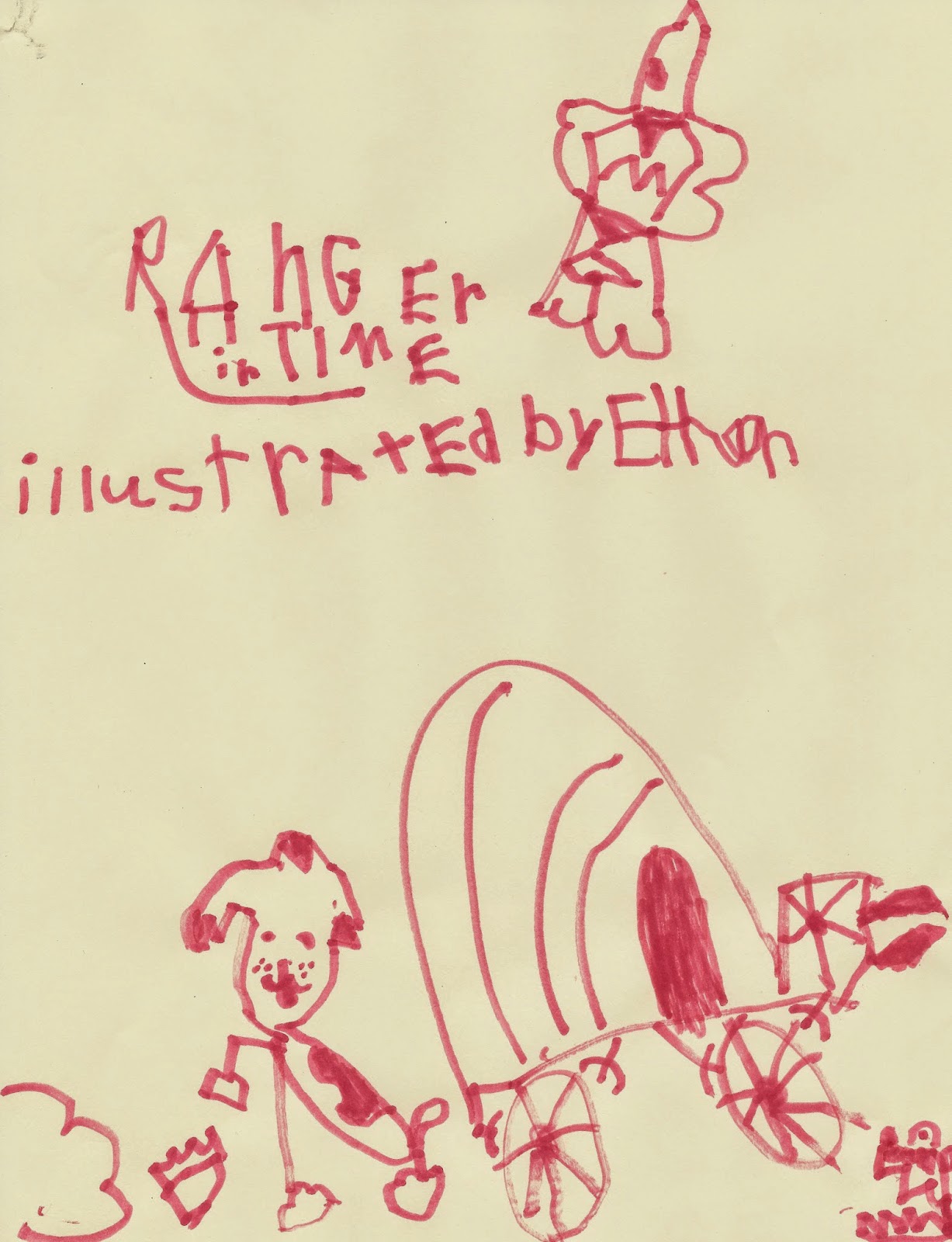
Ethan's Ranger in Time Fan Art
     No one will be able to resist the relationship formed between Sam and his family and Ranger, and readers will feel connected to Ranger themselves as though they are traveling, too. The factual information about westward travel is woven well into the text, making history digestible for developing readers. I read this book aloud with my 6-year old nephew over the Thanksgiving holiday. He loved Ranger and can hardly wait for more!
The Yeti Files, by Kevin Sherry
(Scholastic Press, September 30, 2014)
     This first book in Kevin Sherry's new series introduces cryptids and their enemy, the cryptozoologist who is on a mission to debunk the creatures as mythical. 
     Sherry's artwork and book design will appeal to transitional readers who are looking for a book of length but not prepared for pages of text. The book is highly scaffolded with drawings, including diagrams and maps. My students are grappling to be the next to read this book. 


Sam & Dave Dig a Hole, by Mac Barnett, illustrated by Jon Klassen
(Candlewick, October 14, 2014)
     Sam & Dave set out to dig a hole and find something splendid, but with each move they make, they narrowly miss the treasure they are after.
     Ever a fan of the Barnett/Klassen team and their individual works, this book was a treat for myself at NCTE '14. The artwork is beautiful and telling. With each page and a new "near miss" of the treasure, students are sure to be giggling and slapping their foreheads. 


What I am Currently Reading:
The Friendship Riddle , by Megan Frazer Blakemore
(Bloomsbury USA Childrens, May 5, 2015, ARC)

What I am Reading Next:
Mark of the Thief, by Jennifer Nielsen
All the Bright Places, by Jennifer Niven
How to Outswim a Shark Without a Snorkel, by Jess Keating